The All Blacks’ Missing Move: Why Experience Wasn’t Enough Against Wales
When pressure rises, even deep experience can fail to produce the obvious response. This article examines collective decision-making in the All Blacks’ loss to Wales.
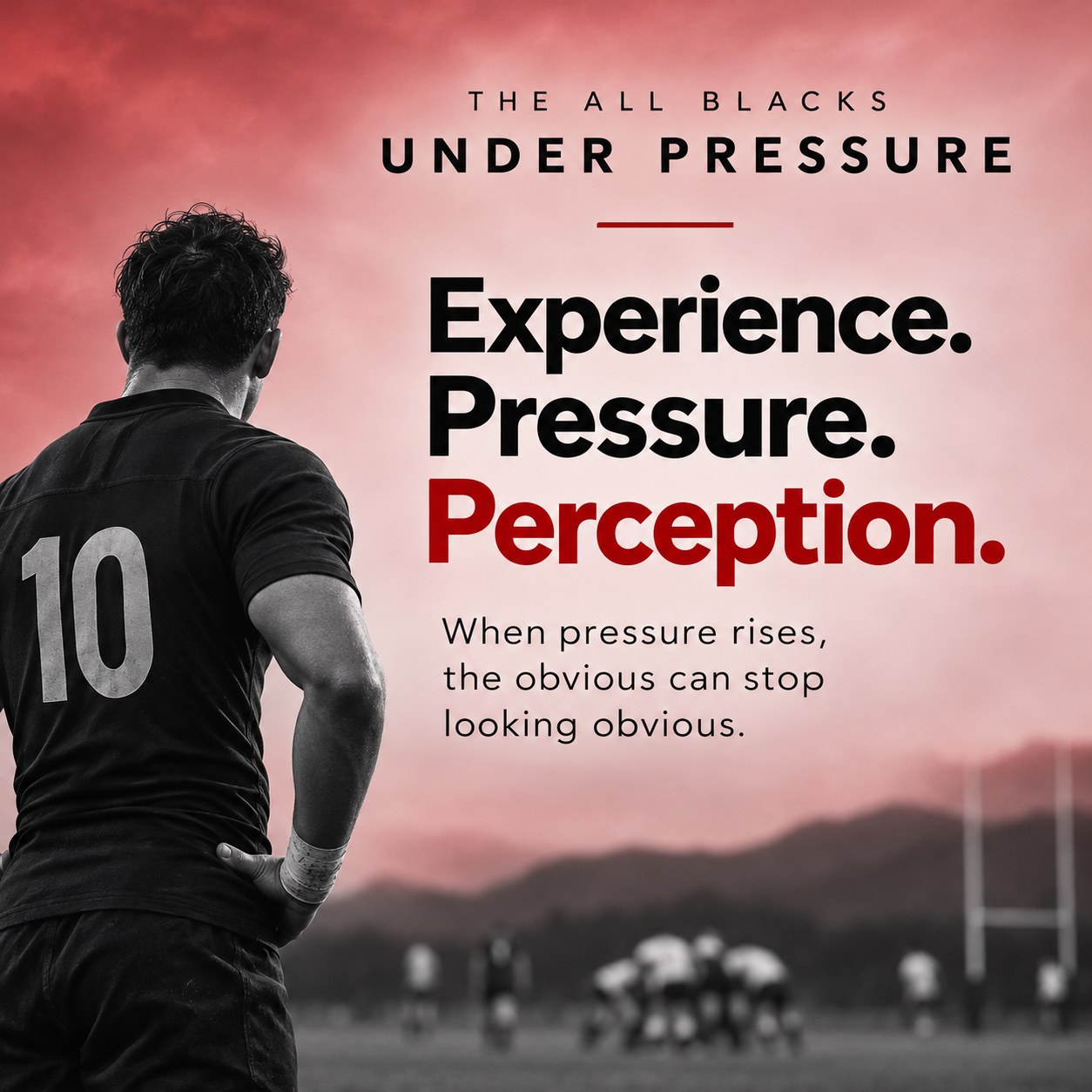
There was something almost unbelievable about watching the All Blacks against Wales. Not simply that they lost, but the way they kept trying to get back into the game. For long periods, they had possession, territory and opportunities. Wales defended superbly and deserve enormous credit for that. But at times, the All Blacks seemed determined to make the job harder than it needed to be.
One off the ruck. Another one off the ruck. Another one. All the while, there appeared to be opportunities to move the ball wider, change the point of attack or take three points and change the scoreboard. It wasn’t that they lacked options. They kept returning to the same response.
After the match, Dave Rennie acknowledged that his players had become one-dimensional and that their decision-making under pressure wasn’t good enough. By Monday, after reviewing the game, he was even more specific. He described around ten examples of players missing what should have been obvious opportunities: Six-on-twos, five-on-twos, players in space who could have been reached with a simple pass.
His explanation was revealing. “Maybe under pressure they just become real tunnel-visioned and carried into contact and didn’t do the obvious.” That is a much more interesting problem than simply not playing well. And it is one we have seen before. Following the South Africa series, I wrote about the strengths Rennie had restored to the All Blacks. Freedom, optimism, trust and the willingness to play what was in front of them. There was genuine evidence that the environment around the players had improved.
But South Africa exposed something else. The All Blacks could create opportunities without always knowing how to sustain them, convert them or recognise when the situation required a different response. The three missing moves I identified were commitment, receptivity and balance. Stay with what is working. Let the situation tell you what it needs. Stop trying to win the whole Test in the next moment. Against Wales, the same difficulty reappeared, perhaps in an even clearer form.
This wasn’t a lack of experience
Rennie acknowledged afterwards that several of his established leaders had been watching from the stands. But Beauden Barrett was captaining the side with nearly 150 Tests behind him. Scott Barrett had more than 90, as did Anton Lienert-Brown (the Welsh starting XV had 479). These are not players who need another few seasons to understand how international rugby works.
There is another uncomfortable point. Some of these same players were on the field when Argentina beat the All Blacks in 2024 and again in 2025. Beauden and Scott Barrett were both there for the record 43–10 defeat to South Africa last year. Different opponents. Different coaches. Plenty of experience.
It would be wrong to assume the same behavioural problem explains all those defeats. But it does raise a question about whether some of the difficulties we're seeing under pressure were already established long before Rennie arrived.
These players have been involved in enormous matches, experienced different defensive systems and dealt with just about every form of pressure the game can produce. They know what a numerical advantage looks like. They know what taking three points can do to a scoreboard. They know that repeatedly running into a well-organised defence does not necessarily become a better idea simply because the previous attempt nearly worked.
Against Wales, the collective response kept narrowing. This suggests the problem is not simply individual experience or ability, but it may have more to do with how the group makes decisions together when the pressure increases. One idea behind The Missing Move is that people can become trapped by responses that have served them extremely well in the past. Experience doesn't necessarily protect against that. It can reinforce the very responses people have relied on for years, even when those responses stop giving them what they need.
The All Blacks have been encouraged to back themselves, look for opportunities and make things happen. Those are valuable qualities, and there is no reason to abandon them. But consider what might happen when they get close to scoring and cannot quite finish it. They believe they are close. Another carry might do it. Wales hold them out. They try again. The next attempt becomes more important because the previous one failed. As frustration increases, the urge to make something happen can grow stronger while the ability to recognise alternatives weakens. The response that is meant to solve the problem may begin reinforcing it.
We cannot know exactly what individual players were thinking. But the repeated behaviour, together with Rennie's description of tunnel vision, makes that a reasonable possibility to examine. Meanwhile, Wales were getting something from every successful defensive stand. Their confidence grew, the crowd became more involved, and the pressure on the All Blacks increased. Rennie recognised that as well. The two teams were influencing one another, and Wales were getting more out of the interaction.
Who interrupts the pattern?
A revealing part of Rennie’s Monday press conference came when he was asked about the players’ decisions to take quick penalties rather than kick for goal or set up other attacking options. He said he prefers to let the players decide. They are on the field, they have a feel for the game, and he trusts their judgement. That is entirely consistent with the environment he has worked to establish.
But it creates a difficult question. What happens when the players’ judgement becomes less reliable under pressure? If the group becomes committed to a particular response, who recognises that and changes it? This is not necessarily about coaches taking decisions away from players. Nor does it mean that kicking a penalty goal would always have been the right answer. It is about having the collective ability to recognise when the situation has changed.
There were moments when three points might have been more valuable than another attempt at seven. Not just because of the scoreboard, but because a successful outcome can change the pressure surrounding the next decision. Maybe another pass would have achieved more than another carry, or when simply continuing with what was already working might have been better than trying to force a breakthrough. Those are questions of commitment, receptivity and balance. They do not require the All Blacks to become a conservative side. They require the players to distinguish between the objective they are committed to and the particular response they are using to achieve it.
The pressure is reaching the environment too
There is another development worth watching. After South Africa, Rennie was still largely talking about building, learning and improving. He acknowledged the losses, but there was a strong sense of looking forward. After Wales, the language became heavier. “We let ourselves down; we let the country down.” He described a quiet group, a painful review and the need to remember how the defeat felt. He also accepted that he should have prepared the team better.
There is nothing wrong with accountability. Rennie is right that a defeat of that significance cannot simply be brushed aside. But there is a tension here. He has identified pressure as one possible reason his players stop recognising and acting on the opportunities in front of them. At the same time, the emotional consequences of poor performance are becoming more prominent.
That does not mean the stronger language caused the problem or will make it worse. It does mean the coaching group needs to be careful about how accountability is translated into better performance. Players can understand perfectly well how much a result matters and still need help making good decisions when that significance starts interfering with their judgement. The solution is unlikely to be reminding them even more forcefully how important winning is.
The problem has moved beyond knowing
The most striking part of the Wales defeat is how closely Rennie’s post-match explanation resembles what we heard after South Africa. The need for better decisions. More accuracy. Sustaining pressure, taking opportunities, and doing the obvious. These are not new discoveries. And that is where the diagnosis becomes more uncomfortable.
A team can spend a great deal of time reviewing its performances, identifying the right lessons and describing exactly what needs to improve. But learning is not demonstrated by how accurately a problem is explained afterwards. It is demonstrated when the next behaviour changes. The All Blacks clearly possess the individual ability to do what Rennie is asking. The group has plenty of experience, and they have demonstrated those skills repeatedly.
What they haven’t demonstrated consistently is the ability to access the appropriate response when the circumstances make it difficult. That is an important distinction. The problem may not be that Rennie has given his players too much freedom. It may be that the environment has not yet developed reliable enough ways for the group to recognise when its current response is failing and make the necessary adjustment.
That is a collective capability, not merely an individual skill. And it is one of the things that separates a group of talented, experienced people from a consistently effective team. Wales deserved their victory. They applied pressure, adapted to what was happening and made the opportunities they created count. The All Blacks had plenty of opportunities of their own. Too often, they appeared unable to change what they were doing when the evidence suggested they should.
After South Africa, we could reasonably describe that as part of a team learning a new approach. After Wales, with so much experience on the field and the same problems appearing again, that explanation is becoming harder to sustain. The All Blacks do not need more experience to know what the obvious thing is. They need to understand why, under pressure, they keep failing to do it.